Kun Wang teaches core and elective courses in the Inamori School of Engineering at Alfred University. They carry the lab's two themes into the classroom: the materials science of metals and ceramics, and the use of data and machine learning in engineering.
CEMS 336: Physical Metallurgy I
Course description
An introduction to the physical and mechanical properties of metals, with an emphasis on relating structure to properties: strength, toughness and ductility, dislocations, phase diagrams, alloying, phase transformations, strengthening mechanisms, heat treatment and solidification, including the processing and properties of plain carbon steels.
The course introduces the deformation and phase-transformation mechanisms that matter most in metals, together with the diagrams and equations metallurgists use to select materials and predict their behavior.
- Offered
- Every fall since 2018
- Prerequisites
- CEMS 214/235/251 or MECH 241/244/320
- Textbook
- Abbaschian, Abbaschian & Reed-Hill, Physical Metallurgy Principles, 4th ed.
Topics
Crystallography; binary phase diagrams; the Fe–C system; hardenability; precipitation strengthening; dislocations; plastic deformation; grain boundaries; fracture, fatigue and creep.
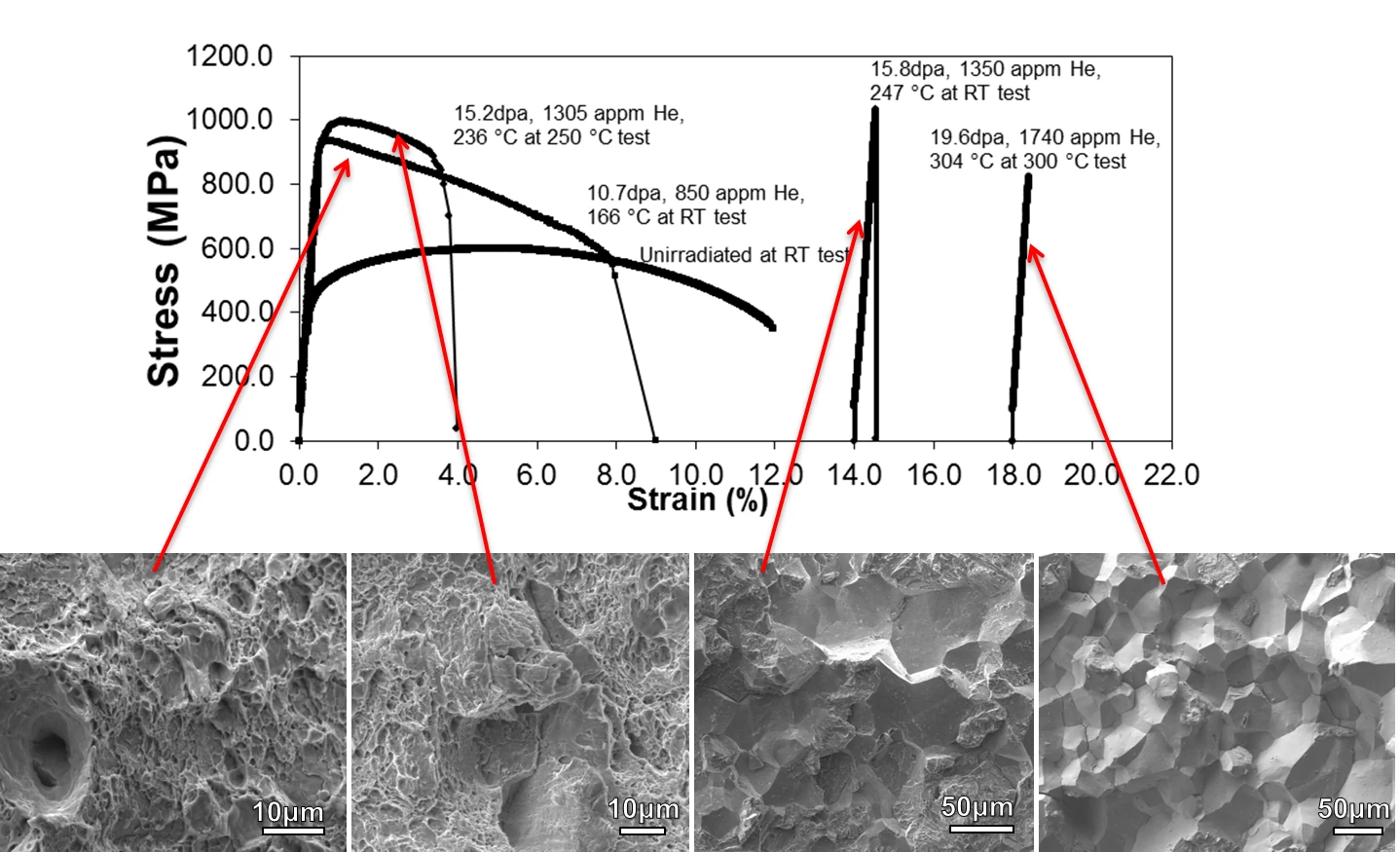
Hands-on course project
Teams of two or three design, process and characterize a metallic material. Recent topics include casting and precipitation strengthening of the team's own alloy composition, hot forging in the Alfred University foundry, and isothermal transformation or quench heat treatment of 4140 and 4340 steels. Each team examines phases, microstructure and mechanical properties by XRD, SEM and hardness testing, then writes a technical report and presents its results.
CEMS 235: Thermodynamics of Materials
Course description
The fundamental concepts of thermodynamics, equilibrium and thermochemistry as they apply to materials systems. Students apply the laws of thermodynamics and the concepts of free energy and equilibrium, and learn the methods needed to solve fundamental and applied thermodynamics problems in materials.
The semester builds from the first and second laws to solutions and the Gibbs free energy of binary systems, the thermodynamic basis of the phase diagrams used throughout materials science. Regular paper homework and short electronic quizzes keep the calculations in practice, with a review session before each in-person exam.
- Offered
- Spring, taught since 2019
- Prerequisites
- CHEM 106, MATH 253, CEMS 214
- Textbook
- Gaskell & Laughlin, Introduction to the Thermodynamics of Materials, 6th ed.
Topics
First law; second law and entropy; statistical interpretation of entropy; auxiliary functions; heat capacity, enthalpy and entropy; one-component phase equilibria; behavior of gases; solutions; free energy and binary phase diagrams.
CEMS 543: Analytical Electron Microscopy
Course description
The principles behind, and practical uses of, electron microscopy in materials research, including electron-microscopy-based analytical techniques, with hands-on laboratory instruction in scanning and transmission electron microscopy. The course is intended for graduate students and researchers who are new users of SEM and TEM.
The course is co-taught with Dr. Darren Stohr. It opens with the SEM section; Dr. Wang teaches the focused-ion-beam and transmission-electron-microscopy section that follows.
- Format
- Lectures and hands-on laboratory sessions
- Textbook
- For the TEM section: Williams & Carter, Transmission Electron Microscopy, 2nd ed.
Topics in the FIB and TEM section
Specimen preparation and FIB; electron sources; lenses, apertures and resolution; holders, pumps and detectors; reciprocal space; electron diffraction; Kikuchi and convergent-beam diffraction; bright-field, dark-field and weak-beam imaging; STEM and EDS analysis.
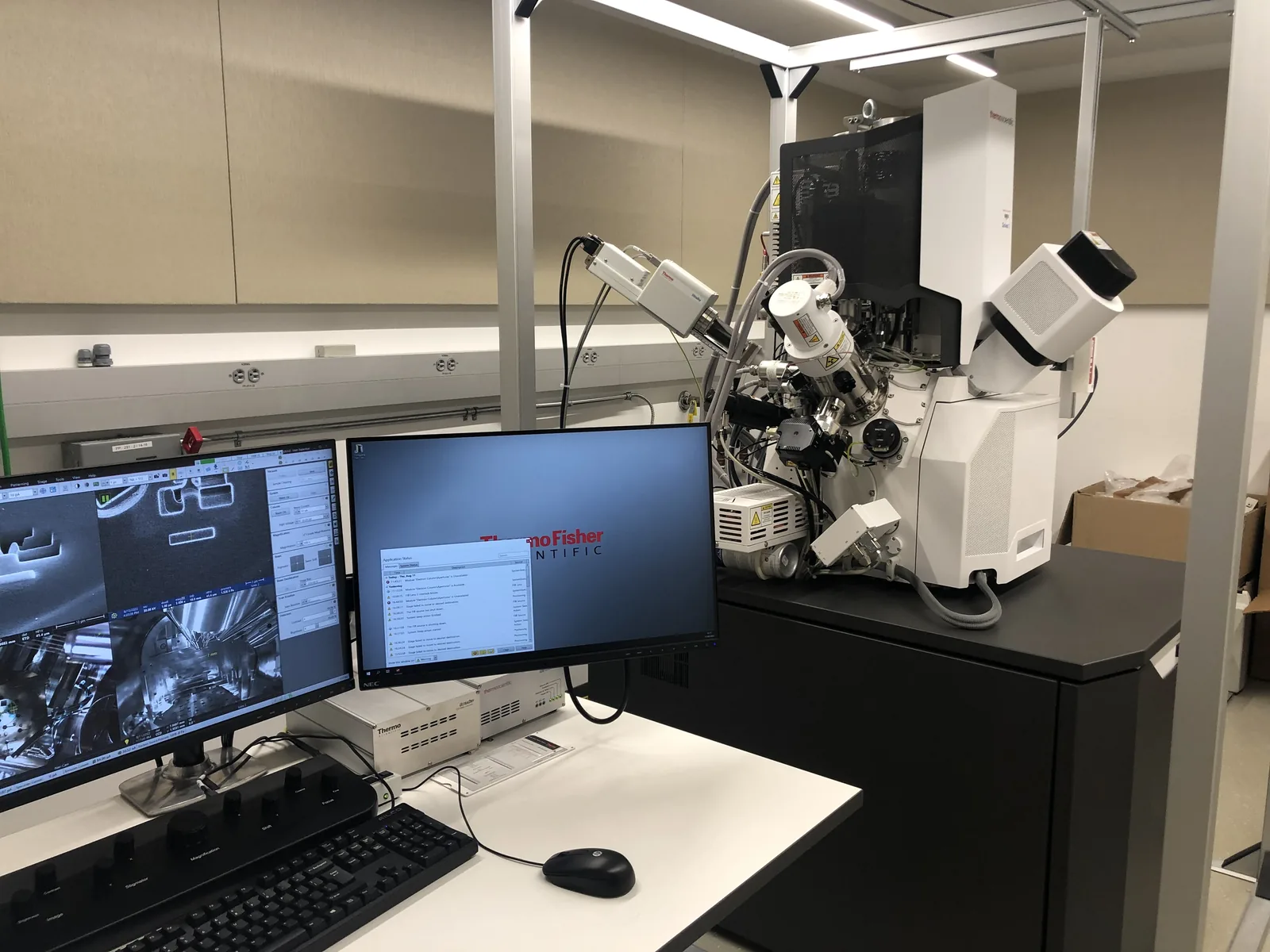
In the laboratory
Students work alongside the instructor on TEM lamella preparation with the focused ion beam, TEM imaging, electron diffraction and elemental analysis in S/TEM, as preparation for formal instrument training.
ENGR 472: Machine Learning Applications
Course description
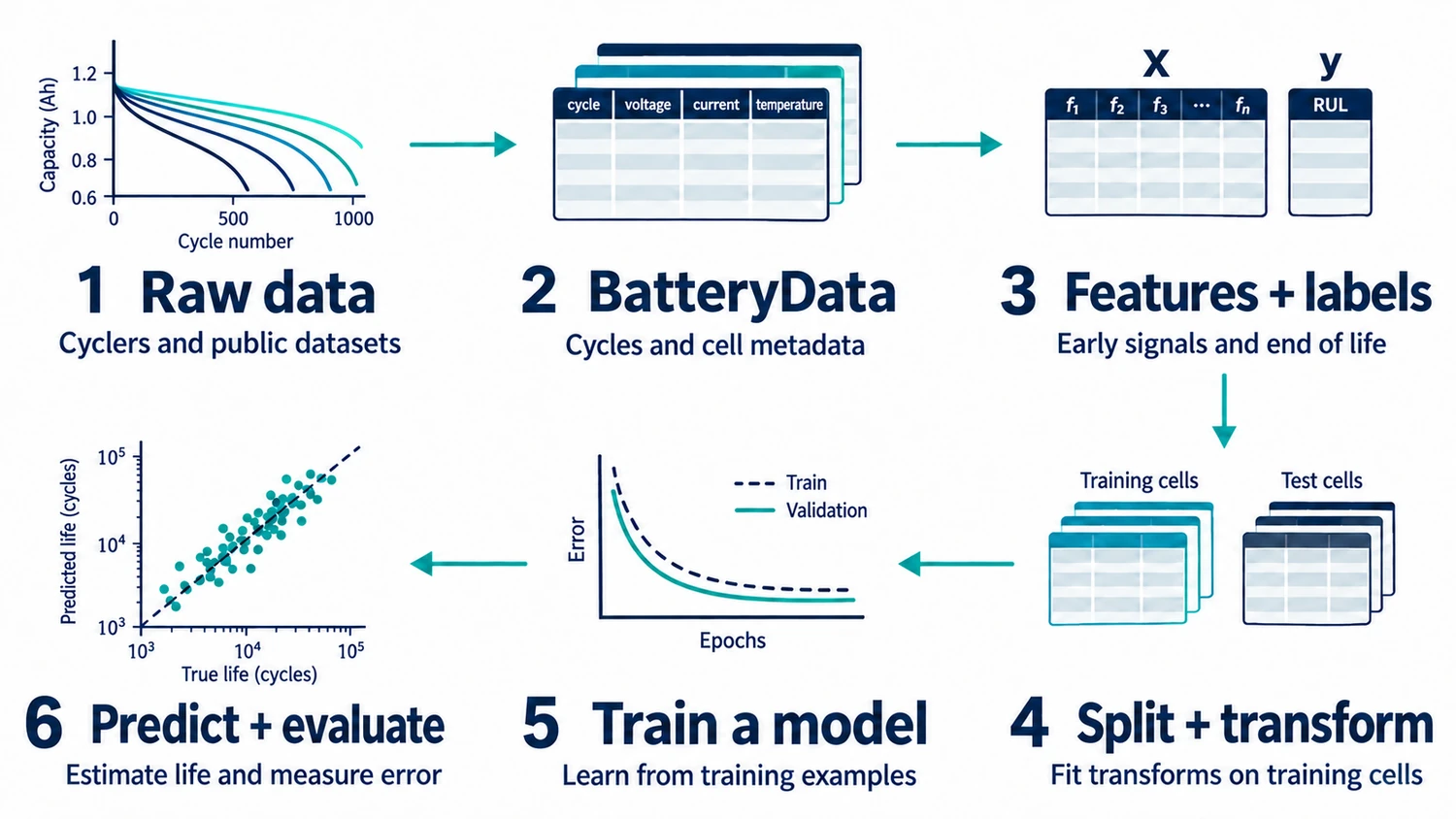
A practical introduction to applying machine learning to engineering data. In the Fall 2026 offering, battery lifetime prediction serves as a case study in which students follow a complete pipeline: assembling public battery-cycling datasets, building features from early-cycle measurements, splitting and normalizing the data, training models that range from linear baselines to neural networks, and judging the predictions with appropriate error metrics.
The emphasis is on understanding what each step does and why, so that the same workflow can be carried over to other engineering and materials datasets. The battery material is also the classroom part of the lab's Battery AI workforce training.
- Tools
- Python and the open-source BatteryML toolkit
Topics
Battery test protocols and data terminology (charge and discharge steps, C-rate, cutoff voltage; state of charge, state of health and remaining useful life); public battery datasets; features from early cycles; train/test splitting and normalization; linear models, random forests and neural networks; loss functions and gradient descent; RMSE, MAE and MAPE.
Battery AI workforce training
Batteries are tested, sorted and managed with data, and the people who will build and run the battery industry need to be able to read that data and to model it. With support from the NSF Energy Storage Engine in Upstate New York, the lab trains students in battery AI: understanding what a battery tester controls and measures, and building machine-learning models that estimate a battery's health and predict how long it will last. The training has two parts.
- In the classroom. ENGR 472 takes students from test protocols and raw cycler files to features, labels and trained models, using public battery datasets and open-source tools.
- In the lab. In the summers of 2025 and 2026, undergraduate researchers supported by the Engine worked on battery AI projects of their own in the lab and presented the results as research posters. The science is described under Artificial intelligence for batteries.
Undergraduate research projects
- Summer 2026 A multi-source Battery Intelligence Platform for state-of-health and remaining-useful-life prediction T. Mberesi
- Summer 2026 Prediction of lithium-ion battery capacity trajectories using a rolling window with CEEMDAN, XGBoost and physics-informed features L. Carstens
- Summer 2025 Using CEEMDAN, SVR and LSTM to predict the capacity trajectory of a battery L. Carstens
- Summer 2025 Using ARIMA and CEEMDAN, SVR and LSTM to predict remaining useful life Y. Katani
- Summer 2025 AI-driven battery material discovery for high-cycle-life cells T. Mberesi
- Summer 2025 Physics-informed neural network for battery materials discovery D. Puga
Course development and outreach
- Course development. Created the hands-on laboratory project in CEMS 336 and co-developed a senior and graduate special-topics course on metallic materials (CEMS 400/500).
- Teaching practice. Participant in the National Effective Teaching Institute (NETI), 2022, and member of the Curriculum Working Group of Alfred University's AI Taskforce, which works on building AI literacy into courses and learning outcomes.
- Outreach. Introductory metallurgy lectures for high-school students, open-house and summer-program activities, and tours of the FIB and TEM laboratories for visitors.